
Tuesday, December 10, 2013
Updates - Ghost, Crank Brothers, Etc.
Got a few new articles up. First, a preview of a Ghost test bike. Next, a summary of my trip to view wheels down in Laguna with Crank Brothers. Nothing more to add that isn't already there. Final Ghost review should be up soon.

Wednesday, October 2, 2013
Suspension Design - Santa Cruz Heckler Vs. Ghost Cagua, Part 2
Okay. I promised a second post where I focused on wheel path an other suspension attributes. I think these diagrams are very telling. We'll start with the Heckler, because it's pretty straight forward.
 As you can see, pretty simple. Sorry for the shitty diagram. This is just a screen shot from Autocad, where I build my simple little suspension models that I use to build the graphs that were shown in Part 1.
Anyhow, what we can learn from this diagram...not much, really. Other than that the rear axle follows a simple path laid out by the main pivot. Let's move on to the Ghost Cagua.
 This is a little bit more complicated as it includes instant center. The instant center (IC) is the point that the rear wheel rotates around. For the Heckler, that point is simply the main pivot. On the Ghost, where the rear wheel path is dictated by the shock linkage and the swingarm, this is not so simple. You can see, the IC starts out way in front of the bike, and gradually moves down towards the bottom bracket, near the end of travel. What does this mean? Nothing, really. Weagle will probably talk to you for hours about IC, but in my mind, it's an end, not a means. What's really important is what happens with your chain growth. Yes, IC will have an impact on your braking characteristics...but there's so many other important factors in braking that override the effect you IC would have, why bother? I anticipate contradiction.
So let's look at the wheel path of these two bikes. Remember that they are vastly different suspension designs. Let's look at them side by side.
 Look pretty similar, no? Let's overlay them.
 That's what I thought. I'm not even sure which is which. Does it really matter though? Two vastly different suspension designs, pretty much identical wheel paths.
Anyhow, what we can learn from this diagram...not much, really. Other than that the rear axle follows a simple path laid out by the main pivot. Let's move on to the Ghost Cagua.
So let's look at the wheel path of these two bikes. Remember that they are vastly different suspension designs. Let's look at them side by side.
Monday, September 9, 2013
Suspension Design - Santa Cruz Heckler vs. Ghost Cagua
I've been lucky enough to have some test bikes at my disposal. And not just a week or whatever...A couple of months with each. And while each bike is profoundly similar (6x6 travel, 650b, etc.) they are also remarkably different (American vs. German, Single Pivot vs. Pseudo Horst Link, etc.).
As I have had both of these bikes for some time, I've managed to plot out both of their suspension characteristics (somewhat). I will follow this up with some wheel path diagrams from my Autocad plots. Feel free to fire away with questions in the comments.
There's one major disclaimer. All of these graphs are based off of Spreadsheets that I created. All of the data for those spreadsheets comes from simple pivot diagrams that I created in Autocad. All of the measurements used to create those diagrams were me with a tape measure. They're pretty close...and an 1/16th of an inch here and there won't make "that" much difference, but there will be some minor discrepancies.
Chainstay Growth vs. Wheel Travel
We will start with an easy one, chainstay growth vs. wheel travel. Weagle looooooves to talk about instant centers and....shit...what's his other one? Oh ya. Anti-squat. It goes on and on. To me, it's a lot simpler than that. Cyclists push down on the pedals when they pedal. This is a downward force (you're essentially jumping on your pedal a bit, right?). The easiest way to counteract that is to build a bit of chain growth into your system (I stress a bit). That force will counteract the force you are putting into your pedals. This is important in about the first 33% of travel. Once beyond 50%, you are most likely not pedaling, and all chain growth does at this point is cause pedal kickback. See how similar the two bikes are with respect to chain growth. The Cagua does not bob at all, so I think they have it nailed. The Heckler has great pedaling characteristics too though.

Shock Travel vs. Vertical Wheel Travel
This graph doesn't really tell us much. But we will use it for other things later.

Leverage Ratio
Here's where it gets a bit weird. Leverage ratio. This is simply the travel at the wheel, divided by the travel at the shock. Which, if you look at the above graph, is the inverse slope of the graph. Simple really. Except...We talk about rising rate and falling rate bikes. Rising rate implies that you require more force at the end of travel to compress a similar distance as earlier in travel. (i.e. 100 pounds compresses an inch of travel early in the travel, but it takes 150 pounds to compress an inch later in travel). Falling rate implies the opposite. However, look at the graph:
 The Heckler leverage
ratio is increasing as we get further into travel, but this is a falling
rate bicycle. What's going on? Well, we talk about leverage ratio
relative to the rear wheel (i.e. the Heckler has a roughly 2.2 leverage
ratio - so the wheel moves 2.2 inches for every inch of the shock).
But when we talk rising rate, we're actually talking about the leverage
ratio at the shock. We'll see that later.
The Heckler leverage
ratio is increasing as we get further into travel, but this is a falling
rate bicycle. What's going on? Well, we talk about leverage ratio
relative to the rear wheel (i.e. the Heckler has a roughly 2.2 leverage
ratio - so the wheel moves 2.2 inches for every inch of the shock).
But when we talk rising rate, we're actually talking about the leverage
ratio at the shock. We'll see that later.
So from this graph we learn that the leverage ratios for these two bikes do the opposite as one another (one goes up, one goes down) and we learn that the Santa Cruz has a slightly lower leverage ratio (which explains why the travel is a bit less than the Cagua with the same travel shock, among other things). These are both very, very simple leverage ratios. If you talk to the designers at Santa Cruz, they love to talk about how they change the rate throughout the travel on their VPP bikes. Falling then rising, or whatever suits the style of bike.
Inverse Leverage Ratio
Here's the graph that really tells us what we need to know about the bike. The inverse leverage ratio is the slope of the Shock Travel vs. Wheel Travel graph. I've compressed the axis of this graph so things really show up.
 So this is where a falling rate bike shows that it is falling rate and a rising rate bike shows that it is rising rate. Santa Cruz counters this by putting a relatively low volume air shock on the bike. I'm assuming Ghost has a bit more volume in their shock...but couple an air shock with a rising rate and you're not going to bottom this bike very easily.
Other Things
In my opinion, you can tell a lot about a bike from these simple graphs. Not everything, but a lot. What we haven't talked about is braking...wheel path...instant centers (Weagle's fave) and many other things. I hope to have more bikes up and more info to follow. At some point.
As I have had both of these bikes for some time, I've managed to plot out both of their suspension characteristics (somewhat). I will follow this up with some wheel path diagrams from my Autocad plots. Feel free to fire away with questions in the comments.
There's one major disclaimer. All of these graphs are based off of Spreadsheets that I created. All of the data for those spreadsheets comes from simple pivot diagrams that I created in Autocad. All of the measurements used to create those diagrams were me with a tape measure. They're pretty close...and an 1/16th of an inch here and there won't make "that" much difference, but there will be some minor discrepancies.
Chainstay Growth vs. Wheel Travel
We will start with an easy one, chainstay growth vs. wheel travel. Weagle looooooves to talk about instant centers and....shit...what's his other one? Oh ya. Anti-squat. It goes on and on. To me, it's a lot simpler than that. Cyclists push down on the pedals when they pedal. This is a downward force (you're essentially jumping on your pedal a bit, right?). The easiest way to counteract that is to build a bit of chain growth into your system (I stress a bit). That force will counteract the force you are putting into your pedals. This is important in about the first 33% of travel. Once beyond 50%, you are most likely not pedaling, and all chain growth does at this point is cause pedal kickback. See how similar the two bikes are with respect to chain growth. The Cagua does not bob at all, so I think they have it nailed. The Heckler has great pedaling characteristics too though.

Shock Travel vs. Vertical Wheel Travel
This graph doesn't really tell us much. But we will use it for other things later.

Leverage Ratio
Here's where it gets a bit weird. Leverage ratio. This is simply the travel at the wheel, divided by the travel at the shock. Which, if you look at the above graph, is the inverse slope of the graph. Simple really. Except...We talk about rising rate and falling rate bikes. Rising rate implies that you require more force at the end of travel to compress a similar distance as earlier in travel. (i.e. 100 pounds compresses an inch of travel early in the travel, but it takes 150 pounds to compress an inch later in travel). Falling rate implies the opposite. However, look at the graph:

So from this graph we learn that the leverage ratios for these two bikes do the opposite as one another (one goes up, one goes down) and we learn that the Santa Cruz has a slightly lower leverage ratio (which explains why the travel is a bit less than the Cagua with the same travel shock, among other things). These are both very, very simple leverage ratios. If you talk to the designers at Santa Cruz, they love to talk about how they change the rate throughout the travel on their VPP bikes. Falling then rising, or whatever suits the style of bike.
Inverse Leverage Ratio
Here's the graph that really tells us what we need to know about the bike. The inverse leverage ratio is the slope of the Shock Travel vs. Wheel Travel graph. I've compressed the axis of this graph so things really show up.

Other Things
In my opinion, you can tell a lot about a bike from these simple graphs. Not everything, but a lot. What we haven't talked about is braking...wheel path...instant centers (Weagle's fave) and many other things. I hope to have more bikes up and more info to follow. At some point.
Tuesday, August 20, 2013
Joyride Slopestyle 2013
Didn't think this would end up getting used, but here it is...
I actually wrote two intros for this. The happier version is up first, the long ass bitter intro following the actual story.


Okay. One more bonus photo. Just because I like it. Wouldn't have included it in the story though.

And now the super bitter intro. Tangential too. And long.
When another friend of mine turned 19, I took over his fake ID. It was from a knuckle dragging mouth breather that we had both gone to high school with. I think he turned 20 before we graduated. That was a gen-you-wine British Columbia Drivers License and that got me in anywhere. Heck, I was doing beer runs for my brothers 25-year-old friends with that thing.
I actually wrote two intros for this. The happier version is up first, the long ass bitter intro following the actual story.
Late to the Party – A tardy look at the 2013 Red Bull
Joyride Spectacle
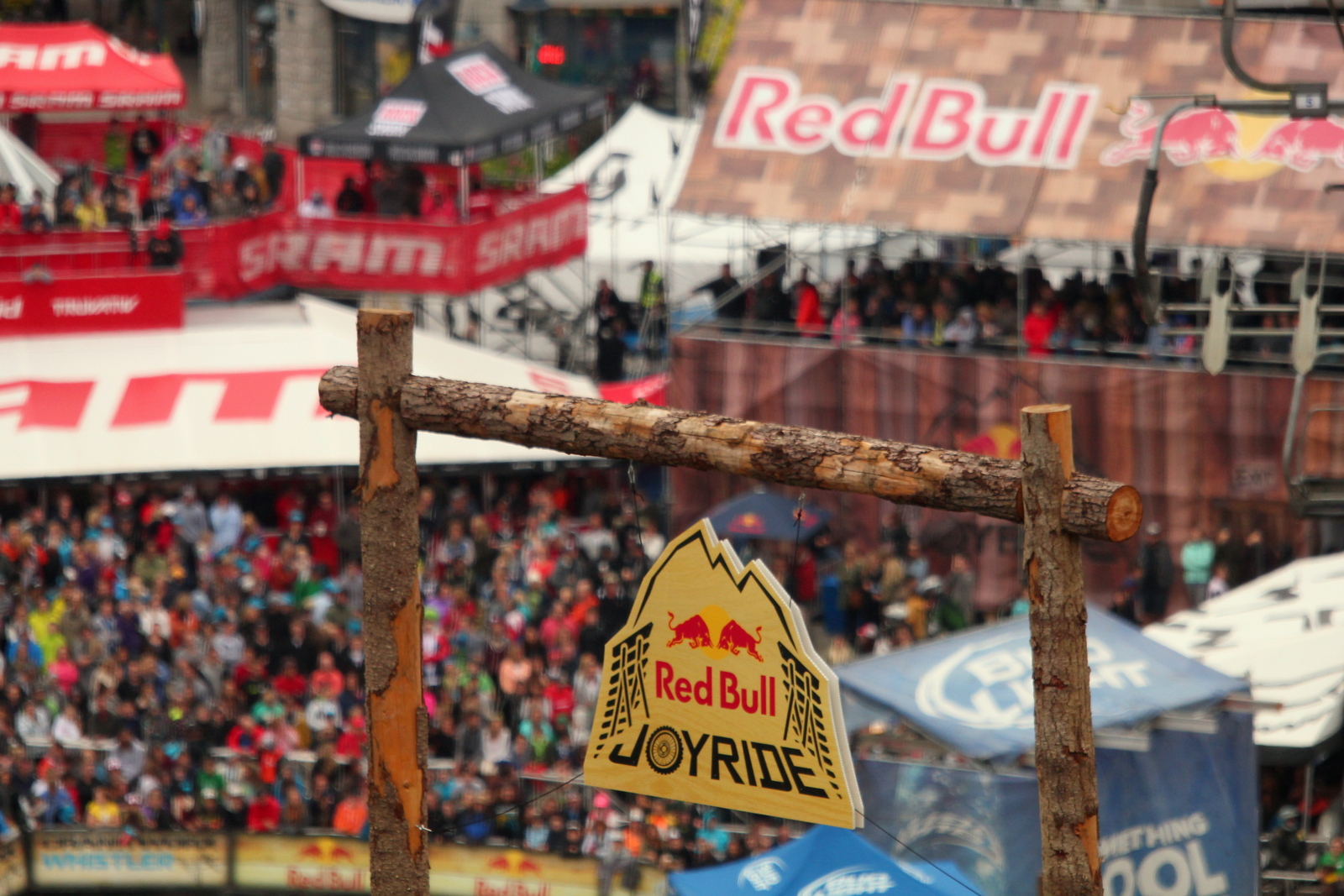
The true meaning of Crankworx. Awesome corporate logo placement.
What’s going on?
Where are we? Who does a triple
whip over bus length gaps? How do these
guys bounce back after hitting the ground so hard? Why are there rocks on the
side of the course? Is this what it
feels like to be old, baffled by the pace at which things are passing you
by? Why so many questions? Why so many cameras? Why bananas?
Why tuck? Where did all of these
people come from? Do they all ride
bikes? Who drinks all this Red Bull anyhow? What is that taste?

Remember a few years ago, when
you would watch the Slopestyle, and there’d be a few things on course and you’d
find yourself thinking “Yeah…I could hit that”?
Those thoughts are funny. You
wouldn’t drop that. Yannick Granieri
lays down the official first drop trick – Some sort of 360 variation.

Don’t worry about that guy conked out on the
landing of this drop, Gully. You’re up
next! On a side note…who didn’t take a photo of Gully standing on
this drop? People really like Gully.

I have no idea who this is…I think I caught
somebodies flash though…Take enough shots and you get lucky sometimes. Lucky meaning you happen to catch somebodies
flash…not like…oh whatever.

Somebody, somewhere high up in Crankworx owns
stock in a Thunder Stick manufacturer I’ll bet.

Not bad for a 19 Year Old. Anton Thelander introduces himself to
Whistler, gets a prize.

Has a spectator ever died at a slopestyle? I’ll put some money down on this guy being
the first at some point in the future.

This was not the triple whip that
Martin Soderstrom did off the same jump later on in the evening. But we can pretend that it was.
Photo 6 TBD
Once again, I brought a knife to a gun fight. What you can’t see is that in addition to the
3 DSLR’s hanging on his shoulder, he also has a sweet Leica hanging around his
neck. Me, well I couldn’t even get my
own decent shot of the guy.

Where do you get this many banana suits?

And you get a helicopter! And you get a helicopter! And you GET A HELICOPTER!

Dude. I’m
serious. Just table your bike a bit and
drop your one hand casually do the side.
It’ll kill!

Or you could just lay down a big
old 360…Yah…That’s way better, actually.

You know things are big time when Sal Masakela is
on the scene.

This photo was taken moments before
Thomas Genon rocketed off the side of the landing over a field of
boulders. These guys are tough.

He was more successful here.

Everybody wants a piece of the champ. I realize that I have not included any action
shots of Mr. Semenuk in this piece. I
felt that enough have been shown already.

Okay.
Fine. One action shot of Semenuk. Ya. I
know. Pretty much the same shot as the
one of Soderstrom. Angles are tougher to
come by when you’re on the outside of the fence looking in.

And now the super bitter intro. Tangential too. And long.
An extremely bitter, cynical and slightly delusional take on
the cycling event known as the Joyride Slopestyle of 2013
I used to looooooooove underage drinking. I mean, really love it. Lucky for me, I was very young when I first
went to University, so there was plenty of opportunities for me to participate
in this favourite of pastimes. We’d
underage drink in our rooms. We’d
underage drink at the bars. We’d
underage drink all over the place. Heck,
I don’t know what I would have done in University if it wasn’t for all of that
underage drinking. Gone to class or
studied or something like that.
I had the sweetest fake ID back then. The first one was actually my friends fake ID
that he had made for him on a class trip to New York City. The photo looked nothing like me and the
lamination was paper thin. It was called
a “United States Identification Card” or something like that. The only thing that salvaged it was that it
had fingerprints on the back. Everybody
assumed it was legit because it had fingerprints on the back.
When another friend of mine turned 19, I took over his fake ID. It was from a knuckle dragging mouth breather that we had both gone to high school with. I think he turned 20 before we graduated. That was a gen-you-wine British Columbia Drivers License and that got me in anywhere. Heck, I was doing beer runs for my brothers 25-year-old friends with that thing.
Oddly, the most difficult place to underage drink was at our
Vanier Park Residence dances that happened every couple of months. See, they only let residents in to these
dances. While “Dave Tolnai” was a
resident of good old Place Vanier, “Mark Smith” was not. They would not let that bum in. It made things difficult.
It was coming up on the stupid Halloween dance, and everybody
was going (that’s another favourite pastime of University students, doing what
everybody else is doing). The situation
looked bleak. But lucky for me, I was a
University student and there was alcohol involved, so my brain dug deep and had
a solution within a few minutes. Everybody
was allowed one guest! All I had to do
was get my friend to put “Mark Smith” on the guest list, I’d flash my fake ID
and we were golden.
The night of the dance came and I got ready, content with my
ingenious solution. We underage drank
some pre-drinks in our room and were off to the dance. Even better, when we got there, a guy I knew
from first year who was now a Residence Advisor was working the door (we’ll
call him “Jeff”). It was all coming up
Millhouse.
“Dave....what is
this?”
“No man. I’m not
Dave. It’s ‘Mark’! I’m ‘Mark’!
See. Right there. ‘Mark’.”
“Dave...man....I can’t let you in with this.”
Flummoxed! All that
hard work, down the drain. I couldn’t
really hold it against Jeff though. He
was just doing his job. Luckily, as
stated above, we were University students and we were talking about
alcohol. This was nothing but a minor
hiccup.
All the students deemed okay to drink were given a stamp on
their hand. That stamp only showed up
under black light. I grabbed my friend
and we went and found somebody who had a black light in their room (what
University student doesn’t have a friend with a black light in their room?). We looked at the stamp and I drew it out on
my own hand in yellow highlighter. Back
to the dance, flash the hand, I’m in and drinking. No worries.
So we’re barely two drinks in and I feel a tap on my
shoulder. It’s Jeff. My “friend” the
advisor. Congratulating me on beating
the system? Giving me a friendly
wink-and-a-nudge with a no-hard-feelings?
No. Throwing my ass out. That power tripping juice monkey was going
out of his way to throw my ass out of the beer garden! I mean...what the hell? It’s one thing to not let somebody through
when you’re surrounded by your peers and some schmuck is trying to pass off a
fake ID in a well lit hallway...but to go out of your way to track him down
once he’s gamed the system and is quietly throwing back a few pops in a
darkened room? That’s a dick move. He quickly became one of my least favourite
people ever and I made his life difficult for the rest of the year.
So congratulations Crankworx. You’re the steroid using, authority seeking,
fun killing jerk of the Slopestyle circuit.
Why you gotta make life so difficult on us poor media? Why you gotta go so far out of your way to
crush the ambitions of us poor 99 percenters on the wrong side of the fence?
“You compete in this years Deep Summer Challenge? No?
Other sided of the fence!”
“You get a shot on the cover of Bike magazine? Oh, you did.
This year? No? Other side of the fence!”
“You the girlfriend of one of our prized 1 percenters? No?
Other side of the fence!”
“Oh, what’s this? You
set foot on our precious slopestyle course?
You don’t have a yellow wrist band, just an officially issued media
pass? Back in the cage, minion!” (it was
an admittedly large cage, running pretty much the length of the course, up and
down both sides. But still a cage.)
Well excuuuuuuuuuse me, Crankworx, for trying to share your
event with the mountain bike community.
Sorry for trying to buy my kids an ice cream cone every once in a
while. What are they going to eat for
dinner tonight, anyhow, Crankworx? Corn
Flakes? Who’s going to pay for the
scurvy medication? You,
Crankworx? Cause I sure am not.
What? You came here to read about bikes? Fine.
Tuesday, June 18, 2013
Heckler 650b
Working on a review of the new Heckler 650b for NSMB. Preview can be seen here.
 To be honest, this is a sweet little bike. Especially when you consider the price. I never imagined that something built with such "budget" parts would give me so much pleasure.
As well, this bike is just so simple. I'm always puzzled when newbies and people with zero mechanical talent buy extremely complicated bikes. Ya, that's what bike shops are for. But after seeing what many of these bikes look like after a few months, I think simple bikes are great for the majority of people. Full review will be up in a few weeks. I'll post an update then.

Update - Final review up here. I think I went way, way too easy on the fork. As well, went and nailed a bonus shot, hopefully for the Santa Cruz Catalogue...

Update Update - Hey. They used the shot. Haven't seen it in the catalog yet, but apparently it is there.


As well, this bike is just so simple. I'm always puzzled when newbies and people with zero mechanical talent buy extremely complicated bikes. Ya, that's what bike shops are for. But after seeing what many of these bikes look like after a few months, I think simple bikes are great for the majority of people. Full review will be up in a few weeks. I'll post an update then.

Update - Final review up here. I think I went way, way too easy on the fork. As well, went and nailed a bonus shot, hopefully for the Santa Cruz Catalogue...

Update Update - Hey. They used the shot. Haven't seen it in the catalog yet, but apparently it is there.
Wednesday, January 30, 2013
This is the greatest invention in the history of cycling


I don't ride with clipless pedals any longer. But I'm thinking of putting a pair on my City bike now, thanks to these. Just super amazing.
Wednesday, January 9, 2013
New Bike For Christmas
This was my latest project. I managed to put it together in secret for Andrea. There's a few things left to do to it, but it's more or less finished.

 It's meant to be a fixed gear, so the tire clearances are really tight. I managed to track down a 120mm Sturmey-Archer 8 speed hub. It was really easy to set up (far easier than an Alfine) but the gearing is a bit weird and will take some work. Your highest gear is 1 to 1, and then you have a series of overdrive gears above that. So I need a smaller chainring.


Subscribe to:
Posts (Atom)